
I was born in Bangladesh in the late 1980s. Being born and raised there, I’ve first-hand knowledge about poverty and how it can paralyze a society in spite of having all other ingredients for success present. I’d seen the giant bubble of extreme poverty that encapsulated the entire population and prevented them from earning anything but humiliation from the world. The bone crushing weight of extreme poverty had snowed the country for many years and barred its people from standing upright and walk towards progress. I’m glad to report that this is no longer the case today and things have improved significantly in Bangladesh. Same thing true for many other places in the world.
To count the number of extremely poor people, aid agencies including United Nations (UN) use a threshold amount such as poverty line and compare peoples’ income with that. According to the World Bank (WB), the global poverty line is currently set at $1.90 a day. Anybody making $1.90 or less is considered to be living in extreme poverty. There were more than 1.9 billion people that lived in extreme poverty in 1981 which was a crazy 44% of the global population (source: WB). Today that number has come down to 641 million, a stunning 66 percent reduction. If the current trends continue, the extreme poverty will continue to go down and there will be around 471 million people remaining by 2030 (source: World Poverty Clock).
The chart below shows the world’s impressive performance in reducing poverty since 1981. It shows the number of people living in extreme poverty in different times. It shows that the highest reduction in extreme poverty achieved during 1981 and 2013. Rapid industrialization in developing countries like China and India along with the use of modern technologies in farming and agriculture have contributed in lifting millions of people out of the ditch of extreme poverty. Although we should seek to feel no comfort in the impressive progress in reducing poverty, it’s good to see that the world has quietly been making progress.

Data Source: World Poverty Clock, UN Population database, and World Bank.
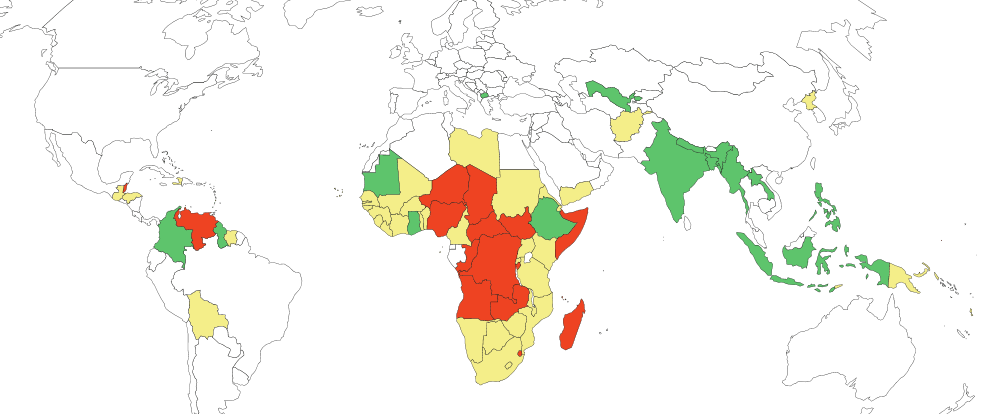
The United Nations has set an ambitious goal also known as Sustainable Development Goal 1 or SDG1, to have extreme poverty in its all forms eradicated from the world by 2030. Many countries, notably in south Asia, have been making remarkable progress towards achieving that goal. One prime example is Bangladesh, which has seen GDP growth over 6% annually. However, the contrary is also seen across sub-Saharan Africa and a few other places in south and central America. Countries like Nigeria and the Democratic Republic of Congo are seeing a rise in extreme poverty. Meanwhile, some nations such as South Africa and Bolivia are working to make slow progress towards SDG1 goal. While this slow progress isn’t enough to deliver on the UN’s SDG1 goal by 2030, nonetheless, millions of people are coming out of extreme poverty every day. On the other hand, all south Asian countries are growing at a rate higher than what’s needed to achieve SDG1 goal, which means no extreme poverty in these countries after 2030. The map below shows the status of each country working towards SDG1 goal.
The countries shown in green are on the path to have extreme poverty eliminated by 2030, while countries shown in yellow are behind the target and will still have many people living in extreme poverty after 2030. In the meantime, the countries shown in red are experiencing an increase in extreme poverty. There aren’t any extreme poverty in the white portions of the map.
Now let’s look at the top 10 countries that have the highest number of people in extreme poverty as of July 19, 2018-
- Nigeria – 87 million
- India – 70 million
- Democratic Republic of Congo – 61 million
- Yemen – 24 million
- Ethiopia – 23 million
- Madagascar – 20 million
- Tanzania – 19 million
- Mozambique – 17 million
- Bangladesh – 16 million
- Kenya – 14 million
Source: World Poverty Clock. Among the top 10 countries with the most poor people, threes are reducing poverty very fast, fours are making slow progress, and the rest threes are doing simply bad.
So, how far will the world go in fulfilling UN’s goal? Sadly, not far enough. If the current trends continue, the world will still have hundreds of millions of people trapped in extreme poverty by the end of 2030. Despite having the most advanced technologies, improvements in healthcare, education, agriculture and manufacturing, we still see millions of people struggling to make their ends met. But overall, extreme poverty is going down in the world, contrary to what many of us believe.


Leave a Reply